International Youth Movement for Peace Through Development
A worldwide movement of young people building the next paradigm of civilization — peace through development, and the creative powers of the human mind.
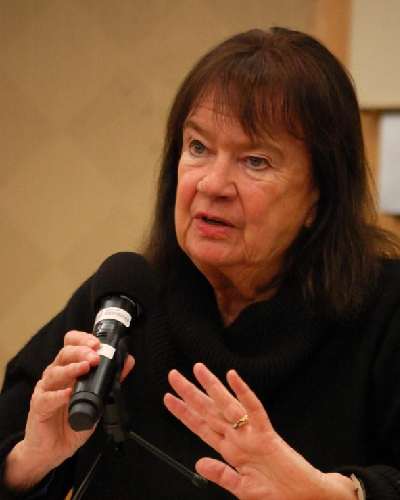
Helga Zepp-LaRouche
Founder, The Schiller Institute
Never has the continuous existence of mankind been so much in danger as right now, not even in the Cold War, or during the Cuban Missile Crisis.
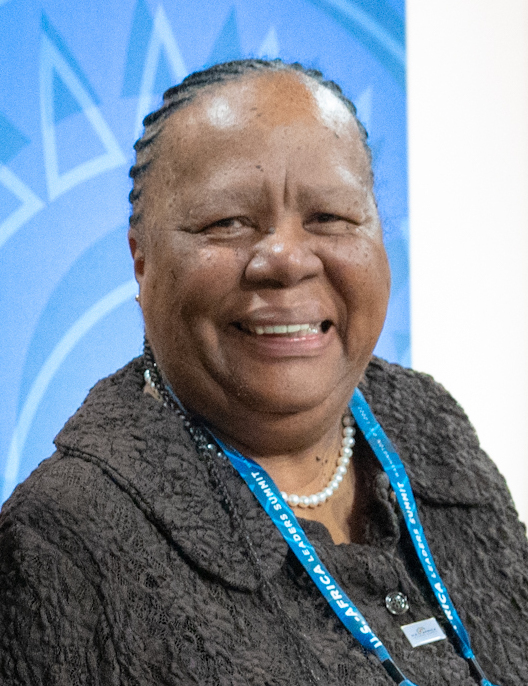
Dr Naledi Pandor
Former Minister of International Relations, South Africa
Global events of the past two decades have engendered despair and much concern among citizens who care in our global community.
Never has the continuous existence of mankind been so much in danger as right now, not even in the Cold War, or during the Cuban Missile Crisis. The two regional wars in Ukraine and Iran are both escalating into what could become a global nuclear war.
International law has been declared as “not needed” or even a detriment to a wrongly understood notion of sovereignty. Diplomacy and negotiations are being dismissed in favour of military solutions. The world economy is in the process of sliding into a depression, comparable to that of the 1930s, the global financial system is hopelessly overindebted.
On the other side, the countries of the Global South are attempting to free themselves by trying to overcome the era of 500 years of colonialism by trying to develop the entire value chain in their own countries. At the First Asian-African summit, the Bandung conference in 1955, Indonesian President Sukarno, Indian Prime Minister Jawaharlal Nehru and Chinese Foreign Minister Zhou Enlai were warning, that colonialism continues in its modern form. Today, 71 years later, that still remains to be the case in the form of the finance- and trade system, among other aspects.
All the more urgent is it therefore, to replace the old disintegrating order with a new global security and development architecture, which must take into account the interest of every nation on the planet.
The youth of the world are being deprived by the present system of their future. It is therefore their inalienable right, to not only make their voice be heard, but to start playing a powerful role internationally, in order to shape the future, they represent. If the young people unite to become a movement of young world citizens, this most important battle in the history of humanity can be won.
Do not let everything the human species has ever produced, all the great discoveries and inventions, all the beautiful creations of music, poetry, painting and other forms of art, be destroyed, just because an oligarchy wants to keep control of the world. Fill your hearts and minds with love for humanity, and you will become the architects of a new era of mankind!
Global events of the past two decades have engendered despair and much concern among citizens who care in our global community. The Ukraine Russia conflict, the ongoing genocide by apartheid Israel in Gaza and the Occupied Palestinian territory, the war in Sudan and the genocide in Dafur, as well as the long war in Eastern Democratic Republic of Congo have all had a terrible toll on residents of these communities.
Further misery to the poorest in our world has been caused by the diversion of development funds to military funding and the growth of the Defence industry and defense budgets. Positive initiatives such as the United Nations Sustainable Development Goals have been ignored and forgotten. The Goals would have halved world poverty and dramatically reduced inequality.
All these events have caused a devastating decline in respect for international law and international treaties and conventions that protect the poor and vulnerable. Institutions such as the United Nations and its various mechanisms no longer offer protection from harm and also find they struggle to survive.
The only hope for the future is our youth. Young people who will commit to tolerance, to democracy to peace and development. The youth of today need to study the geo politics of the present and commit to doing far better when they have the opportunity to lead. Our youth should focus on development priorities such as the Sustainable Development Goals, and Africa’s Agenda 2063.
Focusing on development cooperation and on building partnerships for development our youth can help to build a better world.
International law is critical for building durable relations across nations and communities, youth should support respect for international law and create strong accountability mechanisms to promote adherence to international law. The focus of international cooperation and trade should be fair cooperation and fair trade.
Under the leadership of icons such as Nelson Mandela, South Africa illustrated that it is possible for human beings to build a better world. The youth of today and tomorrow should draw on the example of Mandela and his companions as they strive to create a globe that pursues human dignity, social justice, peace and democracy.
Joint Statement for the Formation of the Global Youth Movement for a Just World Order and New Paradigm
We, the youth of the world, believe that our generation has a responsibility unlike any before it. We have inherited a world filled with incredible scientific achievements, yet millions of us still live in poverty, wars continue to divide nations, and too many people are denied the opportunity to reach their full potential. We refuse to believe that these problems must define our future.
What makes humanity unique is not our wealth, military power, or natural resources. It is our ability to think, discover, and create. Every great step forward in history began with an idea. From agriculture and medicine to electricity and space exploration, human creativity has allowed civilization to overcome challenges that once seemed impossible. The greatest resource any nation possesses is its people and their ability to improve the world through knowledge and innovation.
We believe that every nation has something valuable to contribute. No country should be treated only as a source of raw materials, cheap labor or political influence. No country should be marginalized based on tribe or race. Every nation is home to people with talents, ideas, and dreams that deserve the opportunity to flourish. A just world order must promote education based on creative reason, scientific research, technological progress, and economic development so that every person has the chance to contribute to humanity’s future.
True peace is more than the absence of war. It is a world where people have access to food, clean water, healthcare, education, and meaningful work. It is a world in which nations cooperate instead of competing through conflict and exploitation, recognizing that the progress of one nation can benefit all.
Our generation also has the responsibility to break the cycle of hatred and violence that has been passed down for far too long. The divide between nations based on race or color, economic exploitation, or any other arbitrary difference should stop. Violence has too often been answered with more violence, creating new generations of pain and division. Many have erroneously believed that retribution is a sign of strength while diplomacy is a sign of weakness. That cycle must end with us! We choose cooperation over conflict, dialogue over hatred, and hope over despair. As many are warning today, including such as General (ret.) Harald Kujat, former Inspector General of the German Armed Forces and Chairman of the NATO Military Committee, the world is in a situation similar to that of August 1914. But the joining of the U.S.-Israeli war of aggression against Iran to the NATO proxy war against Russia, the world’s greatest nuclear weapons power, threatens destruction far worse than World War I, including the possible elimination of human civilization itself. The insane commitment by Western governments and institutions to perpetuate this war, even to the point of the use of nuclear weapons, must be stopped now, before we lose absolutely everything in a hellfire. The need for voices of reason to speak in unison, to challenge the irrationalism of “might makes right,” has never been greater.
These conflicts, as well as the wars on the African continent plaguing the innocent citizens of Sudan, the Democratic Republic of the Congo, and many other populations, remind us that a single miscalculation can cause catastrophic consequences for millions of people. At the same time, the unjust war in the Middle East has contributed to instability in global energy markets, disrupted trade routes, and increased the risk of economic shocks that affect both developed and developing nations. Rising fuel prices, inflation, and food insecurity due to the disruption of the fertilizer industry are causing famine. You may be traveling, but people in many developing nations have packed their cars away, unable to cope with rising fuel prices. You may be eating your daily bread, but many of us are not.
The world is a global village. Conflicts that rise in one part of the world often create a ripple effect through a disproportionate share of economic consequences in the other parts of the world. This reality demonstrates that lasting peace cannot be achieved through military power alone. It must be built upon economic development, scientific advancement, technological innovation, mutual respect among nations, and a shared commitment to solving humanity’s common challenges.
There is only one realistic path toward safeguarding world peace: the international community must urgently place the creation of a new global security and development architecture at the center of its agenda and work collectively to establish a renewed framework for international relations. This framework should be firmly grounded in the principles of the United Nations Charter, the Five Principles of Peaceful Coexistence, and the lessons of the Peace of Westphalia, which demonstrated that lasting peace can only be achieved when the legitimate interests and concerns of all parties are recognized and respected.
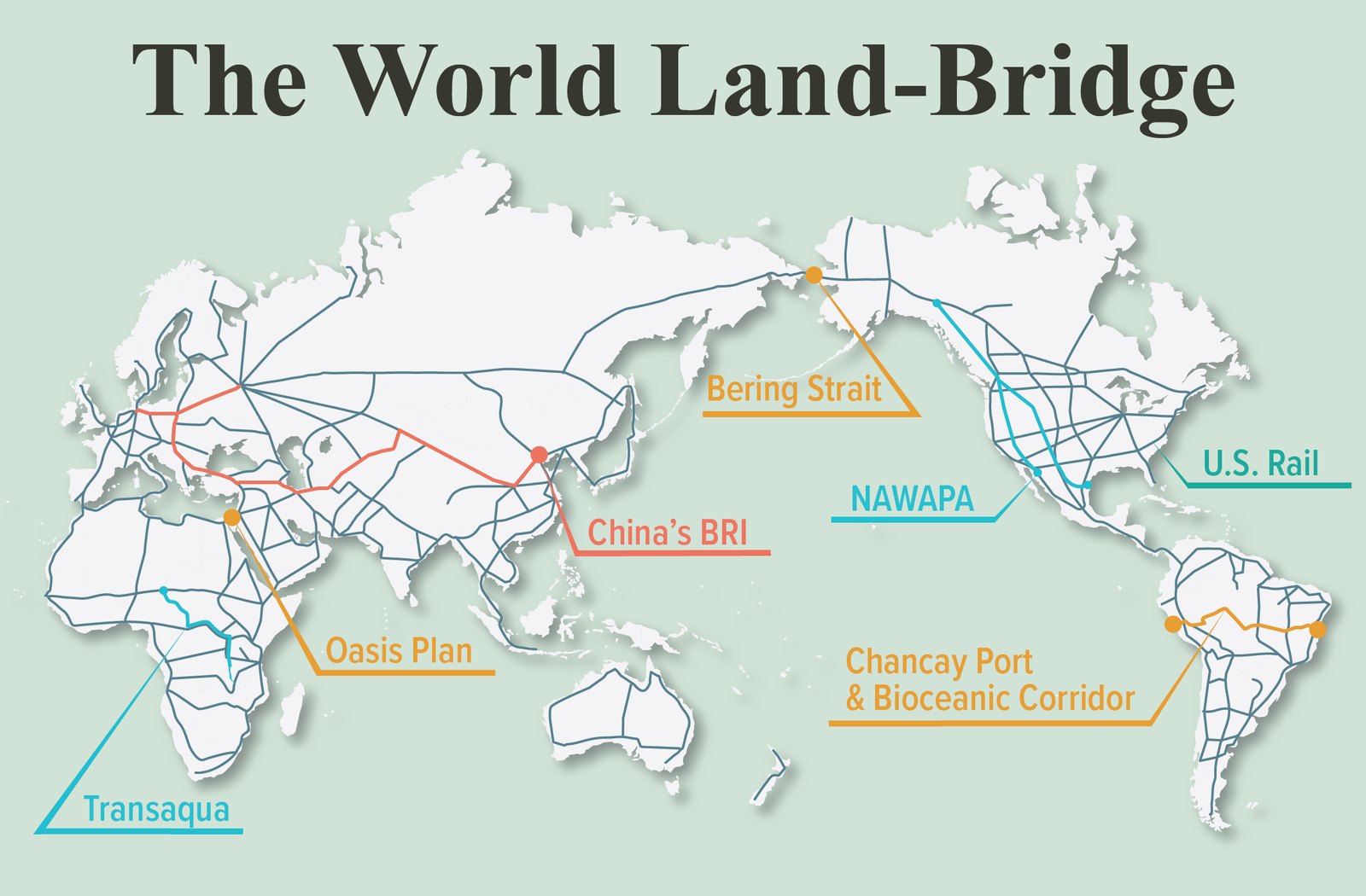
In essence, the principle of indivisible security must once again become a cornerstone of international relations. Alongside the Schiller Institute’s proposal for a new global architecture, outlined in Helga Zepp-LaRouche’s Ten Principles of a New International Security and Development Architecture, China has also put forward a broad vision through its four global initiatives, particularly the Global Governance Initiative, which represents one of the most comprehensive contributions to the discussion on building a more cooperative, secure, and development-oriented international order. Initiatives such as the Belt and Road, the construction of major enablers of economic development such as ports, roads, and high speed rail coincide with the Schiller Institute’s proposal of the World Land-Bridge, a global vision of using interconnected continental development corridors to eliminate poverty.
Among the elements of that vision are the African continental high-speed rail network included in the African Union’s Agenda 2063; the expanded LaRouche Oasis Plan, a fifty-year development plan for Palestine, Israel, and the entire region focused on nuclear desalination, canals, and transport; the Transaqua Project to transfer water from the Congo River to refill Lake Chad, which would benefit 40 million people in 12 nations and provide the basis for the development of the entire Central African region; the Bioceanic Corridor, a high-speed railway linking Peru’s Chancay Port, the most advanced deep water port in South America, to the Atlantic coast of Brazil; NAWAPA-PHLINO, the North American Water and Power Alliance and the North-West Hydraulic Plan of Mexico, a combined continental water-management project designed to transfer water from Alaska through Canada, the western United States, and Mexico; and the Bering Strait Tunnel, a 53-mile underwater tunnel to connect North America to Eurasia by rail.
How beautiful will it be for the youth to participate in these beautiful ideas and projects that will shape the coming fifty years of humanity.
As the youth of the new International Youth Movement, we are committed to taking our vision beyond words and into the world’s most influential decision-making platforms. We will actively present our ideas and advocate for a new paradigm of peace through development. We direct our call for a new paradigm of peace through development to the participants of the various upcoming intergovernmental summits of 2026 and 2027, including the August Shanghai Cooperation Organization (SCO) Conference, the September United Nations General Assembly, the September BRICS Summit, whose participants represent the majority of the population of the youth in the world, and February’s 40th African Union Summit, reflecting the largest youth population in the world, predicted to reach 42% of the world youth population by 2030. Heads of state, policymakers, international organizations, business leaders, academics, and fellow young people, it is time to embrace science, technology, economic cooperation, and human centered development as the foundation for lasting peace. We believe that the voices of young people must not merely be heard—youth leaders must definitively shape the policies that will determine their own future. We therefore call on governments and international organizations to adopt the necessary principles and policies outlined in this document, and others that are necessary to bring this vision into reality, in the immediate term.
The youth believe that the future will be shaped not by fear, but by our willingness to work together for the common good. Thank you.
Viewing Africa’s Current Crisis from the Vantage Point of Universal History
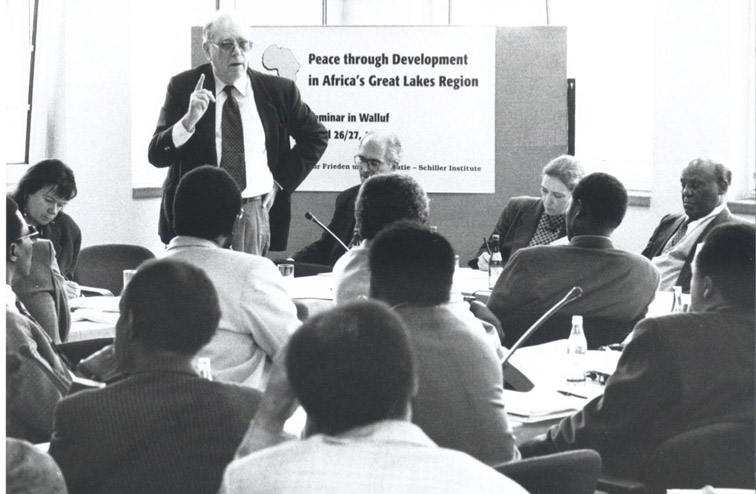
Excerpted from the speech delivered by Lyndon H. LaRouche, Jr. on April 26, 1997, to the Schiller Institute conference “Peace Through Development in Africa’s Great Lakes Region,” Walluf, Germany. First published in EIR, Vol. 24, No. 22, May 23, 1997.
Lyndon LaRouche addresses African diplomats and guests at the Schiller Institute conference “Peace Through Development in Africa’s Great Lakes Region,” Walluf, Germany, April 26, 1997. EIRNS/Christopher Lewis
Although I am interested in many of these subjects, and involved in many of the topics which will be discussed today, I thought it more appropriate that I address the one topic which no one else would address, which is the situation in the world, which defines the situation in Africa.
Now, I ask you to step out of being Africans for a moment, and go up to the top of a mountain, where you can see in the distance both the breadth of this planet’s population, and also, see into its past, several hundred years. And, look at the situation that we’re in; look down on this planet on which you happen to live, but stay on the mountaintop for a while, and say, What is going on, around the whole world?
Let’s look at Africa, and its development, and its pain of today, in terms of what is happening around the world. And what you see is, this planetary civilization is disintegrating!
We’re on the verge, in the process actually, of the greatest financial collapse, globally, in all human history. We’re at the point that the monetary systems of every country, with possibly the exception of China, can disintegrate on a given morning. That is, we could have a chain reaction in financial speculation, which, within 48 to 72 hours, can annihilate every currency, every bank on this planet, simply because everything freezes; money is no longer negotiable, because of the collapse. That can happen.
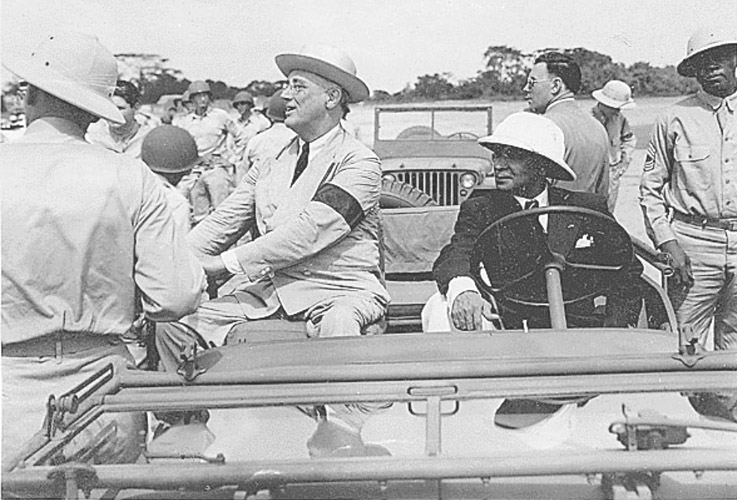
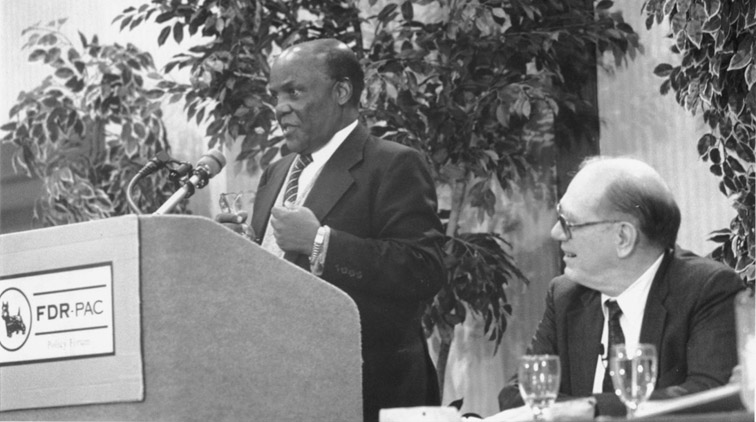
President Franklin Roosevelt in Liberia, 1943 — from the same EIR article.Godfrey Binaisa, former President of Uganda — from the same EIR article.
Continue reading — the full speech traces mankind’s nature as a creature of ideas, and Africa’s place in universal history.Read on larouchepub.com ↗
You look in the United States, over the past 30 years—again, stretch back into the past. Look at the standard of living in the United States for a typical family, and look at the contribution to that standard of living represented by the income of one working member of that family, 30 years ago. Now, look today at a comparable family. The standard of living in consumption, physical consumption, is half. The quality of medical care available is also about half. The educational level, I would say—maybe I exaggerate, but I don’t think so—is about zero what it was years ago. The graduates of a university in the United States today are almost a different, inferior species to what they were—and they were pretty bad, 30 years ago. As a matter of fact, they’ve almost achieved the nadir achieved by royalty in Britain.
Look at the condition of Europe. Go through the list in Germany, or France, or Italy, of the great industries which once existed. Look at the great banks. Pick up a newspaper in Zurich about the condition of the Swiss banks. Look at the mighty Japan. Pick up a newspaper, and look at the mighty Japan. We see all across this planet, a disintegration of civilization. Look in the former Soviet Union. Look in the Middle East. We have a dying civilization. Then, look at Africa, where Prince Philip, in 1961, committed himself to defend the beast, and said he were one, in his plurality. As a matter of fact, he moved to try to defend his putative relatives, the gorillas of Rwanda—that’s his conception of man, I think. Look at these conditions today. You say, this is the end.
Now, what does this mean? Before we go back to Africa as such, what does this mean about this civilization, in which Africa is locked?
What Is Man?
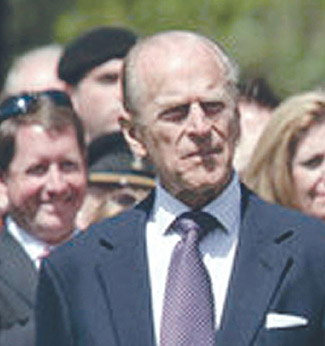
Prince Philip Mountbatten, consort to the United Kingdom’s Queen Elizabeth II. Public Domain
Now, what is man? Man is not, contrary to Prince Philip, an ape. He could be an ape if he chooses to be; we’ll find a zoo for him. But man is not by nature an ape. Because human beings, if they were apes, or like great apes, would never have exceeded several million people, in numbers upon this planet, during the past two million years of conditions of life. An ape-like man could not achieve a higher level of population, on this planet, at any time, during the past two million years, in excess of several million individuals. But man, by the end of the Fourteenth Century in Europe, populated this planet with several hundred million—approximately the level it had been during the time of the Roman Empire. And, since the Fifteenth Century, the population of the planet has increased to over five billion people. And generally, until the middle of the 1960s, there was a general improvement in the life expectancy and conditions of life of people.
As you know, in Africa itself, just to glimpse back at Africa for one moment, what is happening in Central Africa, in respect to life expectancy, even without this genocide: The life expectancy is dropping. Diseases which had been half-conquered, are now returning—deadly diseases. Lassa fever is spreading; Ebola is spreading; the HIV, the human immune-deficiency virus, is rampant, killing off populations. Famine conditions, nutritional conditions exist, which are lowering, actuarially, the life expectancies of people throughout Africa. But then, look at Africa again, look at the planet. Look at it over the past 400-500 years. And, look at it over the past 30 years.
During the past 30 years, we have seen a descent from a world civilization which was increasing the power of the individual, increasing life expectancy, increasing standard of living, increasing productivity, improving the environment, in fact, by cleaning up some messes we used to make—and, over the past 30 years, everything has become worse. Now, why did everything become worse? Was it an act of God? Did the Hale-Bopp comet [visible to the naked eye for 18 months in 1996 and 1997—ed.] drop disaster upon this planet? Or, was it the will of man, that brought about mankind’s own destruction, the destruction of this civilization?
Mankind is not an animal; we are not a creature of habit ingrained in us biologically. We are a creature of mind. Hence, we are in the image of God. We have the power to exert dominion in the universe. We have the power to increase man’s power over the universe; to change the conditions in the universe, so that we may increase in number, so that our life expectancy may be increased, our health improved, and above all, the development of our minds advanced. And by these means, everything good that man has accomplished has been accomplished. When something goes wrong with mankind, very rarely does anything bad happen, which mankind did not bring upon itself.
How does mankind live, in relationship to the universe? By ideas. Language was not dropped upon us; it was developed. A whole series of discoveries, which are reflected in the evolution of languages, which we acquire from our parents, and so forth, and so on. They are inventions.
For example, here in Germany, there was a kind of civilization, we now know, in the Harz Mountain region, about 500,000 years ago. Someone in a Harz mine, digging in there, found a site which dated from about 500,000 B.C. In this site, they discovered artifacts of human existence, including a throwing spear made of hardwood, perfectly balanced, as the one-third length throwing spear. And other signs of civilized life. Now, this is actually two glacial ages before this time. But from all these ancient ages which are lost in the mist, beyond what we know about the past six to seven thousand years of human existence, which is all we know about history and pre-history generally, except a few odd bits, here and there.
Storehouse of Ideas
All these thousands of years, and hundreds of thousands of years, before, our predecessors were generating discoveries, which were transmitted and re-experienced by their children. These discoveries include language, and all these other things. These discoveries, we can call ideas. Mankind is a creature of ideas. Mankind has had many crises; many societies have failed, because they lacked an idea which was necessary to deal with their mistakes. And other societies have arisen which discovered the idea, which solved that mistake, and so, mankind went through a crisis and then came out of it again someplace else. And this storehouse of ideas, of all human achievement, is now embodied in people from various parts of this planet. And is the common stock and property of us all. The common contribution of all ancestors of all humanity, of those proven and valid ideas.
That’s how we exist. We don’t exist because we were born yesterday, and went out and conquered the planet, and did something wonderful. We exist because our predecessors developed and practiced ideas, which were given to us as a heritage at the time we were born. And if we had education, we had more of these ideas. Therefore, when civilization generally collapses, one should not look in any particular part of it, to find the cause of the collapse. The disease of disintegration is nearly everywhere.
But how does this happen? How do people rule themselves? By their minds, by their ideas, their opinions, their practice. Which means, there is something wrong in the head of mankind. Something has gone terribly wrong, that was not as terribly wrong 30 years ago. But the fact that we accepted bad ideas 30 years ago, approximately, was made possible because there were defects in the world civilization existing previously, which allowed this to occur. What we’re looking at is a crisis of civilization, in which then, one can understand Africa. Because the crisis of civilization, the collapse of civilization, has closed in upon and struck Africa.
Where do we stand today?
The clock is nearly at midnight. I don’t know what day, exactly, or what month or what week this system will collapse, but it will be soon. It will not be ten years from now, it will not be five years from now, it will be soon. The collapse will occur—if he’s still living, if they haven’t shot him—while President Clinton, of the United States, is still President. It will occur soon. Nothing can save the financial system. Nothing can save the IMF, and what it represents today. Nothing. It’s impossible! It’s self-destructing. It’s the Titanic, which is already holed, it is going under the water. Nothing can save it. It will never float again. And if humanity doesn’t get off the Titanic, they’ll go down with it. You can’t save this civilization.
We’ve seen things like this earlier in history. We call it the brink of a Dark Age. Africa has seen a number of dark ages, where civilizations existed, then some catastrophe has occurred, and the whole culture collapsed. Mass death. Collapse of life expectancy. Virtual extinction of whole parts of the culture. We’re now seeing this on a planetary basis.
As a result of the changes in technology and ideas, which occurred in the past 500 years, radiating from Europe, the population of this planet increased from over several hundred million, which had been the highest level achieved since the time of the Roman Empire, to five billion, in about 500 years. The greatest rate of increase and improvement in the demographic characteristics of human existence in all known, or assumed, or inferable existence of mankind. The existence of a population of present characteristics, say of 1965-1966; present family, demographic, population characteristics, education, culture, productive power, is a result of this accumulation of institutions associated with the modern nation-state economy.
It was the state development of infrastructure, the state promotion of public education, the increases in the universality and scope of education, first to the development in the Nineteenth Century of the universal secondary school, which did not exist prior to the Nineteenth Century, as in Germany and the United States and elsewhere. Then, the development of access to university education, in the late Nineteenth Century and the Twentieth Century. The general idea of the right of access to a university education, did not exist in the United States until the end of World War II, when it was first established by the so-called GI Bill of Rights, which allowed any veteran who was qualified, to be supported in a university education. It never existed before.
Responsibility of the Nation-State
But it is this body of ideas, this education, this improved condition of life, on which this population level depends. And, without the nation-state, that doesn’t exist. Global society doesn’t exist. It is the responsibility of the nation-state to take care of all of the territory, and all of the people; to provide education to all of the people. These are the conditions which we know, from this experience, on which the whole population potential of this planet depends. And without the nation-state, this is not done.
The responsibility of government, is to rule over the economy; not to privatize it. Private initiative, yes, in creation, in production, in various ways; but you must create the conditions for that initiative. Without railroads, without roads, without power, without water management, without education, without regulation and protection, this is not possible. Therefore, if you destroy the institution of the nation-state, what happens to the population level?
We now have artificial conditions of famine on this planet—that is, imposed by policy, by the IMF, World Bank, and other institutions, which have created an artificial food shortage. Africa could more than feed itself, with its existing land, if it had nation-states and development. No problem. But what has happened? A collapse of the possibility of human existence, means a reduction in population. It means a reduction, very rapidly, to a potential about 20% of what it is today. This means that the human population will be collapsing, over a period of about two generations, in the direction of the levels of demographic characteristics, the levels of total population, of the Fourteenth Century: several hundred million people on the planet as a whole, within less than two generations.
You see that going on in Africa, right now.
In Zaire, for example. Zaire was disintegrating, by orders given by the IMF and others to Mobutu. No army, no central administration, no nothing. Keep your little preserve. And let the country disintegrate, fall apart. Let the diamond dealers, the diamond concessions, the metal concessions, the gold concessions, the oil concessions take it over, piece by piece. Set up certain enclaves: Set up gold mine enclaves, diamond mine enclaves, zinc enclaves, copper enclaves. Guard these enclaves with mercenaries! Not government, but mercenaries.
And the rest of the territory around, except for one exception, is terra incognita—no man’s land, where bands of wild people prey upon each other. With one exception: You have this nice mountain area, around Lake Victoria, the highlands, where Europeans would like to settle. Unfortunately, this nice land is overcrowded by Africans, who can be eliminated, to make way for nice houses for the Europeans, who move in to make their headquarters, from which they operate the mines in northeast Zaire (our friend from Lado has a different opinion about who owns that area), or, from Kivu and from Shaba, and so on.
So, this is the chaos, this is the new Dark Age, like the end of the Roman Empire in Western Europe, or the collapse in the middle of the Fourteenth Century, the banking collapse. And we see in Africa, a collapse of civilization, which is a warning sign of what will happen to this entire planet, unless we rid ourselves of those institutional ideas which are responsible for the global collapse which is visible throughout the planet, in large part, over the past 30 years.
China Has Greatly Improved
The only part of this planet, in which this has been significantly reversed, for special reasons, is under the leadership, in the past 15 or so years, of the recently deceased Deng Xiaoping, in China. China has greatly improved, with many contradictions involved, but has greatly improved its conditions. It is the only part of this planet which has seen a significant improvement of conditions during any part of the last 30 years, coming out of the “Great Proletarian Cultural Revolution” nightmare, which was going on earlier in China.
The rest of this planet is a disaster, and the disaster lies in the ideas in the heads of influential people, and the toleration of those ideas by the general population. Just think: How many people defend neo-Malthusian ideas today? How many people say the elephants are more important than the people? The gorillas are more important than the people? That’s an idea.
So, you kill the people, even to protect an insignificant bacterium. This has come to that point! Somebody discovers a bacterium, or a microscopic organism, of a specific species, and says it’s “endangered.” Or some kind of insect—a variety of insect, not even a species, just a different coloration—that becomes an “endangered species.” What is done to human beings, to protect that species, in the name of protecting that species? That’s an idea, one of the immoralities.
Former President of Uganda, Godfrey Binaisa, addresses an FDR PAC forum on Africa, with Lyndon LaRouche, in Washington, D.C., Jan. 25, 1997. EIRNS/Stuart Lewis
Who says that nuclear energy is bad? That was not thought 30 years ago, and it was not bad. Like anything else, you should use it properly, you should know how to handle it. You shouldn’t give it to people like members of the British Royal Family, who are incompetent to handle these things. But Africa needs it desperately! Without the energy density which only nuclear plants can supply, you cannot supply the level of energy density required to meet the requirements of the African population, that is, to maintain an African equivalent of a European standard of living and demographics.
Everything else, the same thing. Free trade: destroy the right of a nation to protect itself, protect its economy. For example, take any African country. You want to set up an industry? So, the government decides to protect a certain industry, or a certain kind of agriculture. So, the government sets up trade and tariff agreements—or used to—to make it possible for that kind of agriculture, that kind of industry, to develop in that country. And you would supply protection against foreign competition, for that industry, in order to build it up, because without it, you lag.
What happened to that? No, global society, the unimpeded global spread of disintegration of the economy. People go into one country after another, setting up slave-labor shops, in the name of “outsourcing,” and then they move on, to another place, where the labor is cheaper. This slave-labor shop actually works people at slave-labor conditions. What happens when people work under slave-labor conditions? They become sick, they become diseased; all the population around them collapses, the culture collapses.
Those are the conditions we’re facing. With bad ideas.
Now, we come, when you talk about ideas, you say, now, how is mankind forced to develop new ideas—when man does develop new ideas?
Well, we run along with, we believe certain things; we act on those beliefs. Then we come to a point where something happens, and our system doesn’t seem to work any more. The very mind with which we believed that the old ideas were proven and valid, comes up against a fact; that the same mind recognizes a fact which shows the old system doesn’t work. This is called a paradox; because with the same mind, we see on the one side that we believe this to be true—our tradition—then, with the same mind, with the same ability, we say, “This is also true.” But the two can’t live in the same universe. This is a paradox. And, then the mind is forced to use the creative power of the human mind (which only the human mind has), to develop a new discovery of principle, and to act upon that to solve these problems.
This System Is Coming to an End
Humanity is coming to such a point. The system of free trade, the system of Malthusianism, this system of parasitism, is coming to the end. The same mind that can perceive the system and its rules, can also perceive that the system as a whole is not working. There’s no one of any significance in leadership of nations today, which will deny—privately, at least—will deny, this system in its present form is coming to an immediate end. Not merely in one country or another, but globally.
Let’s skip for a moment, before coming back to that theme, to look at what is the policy for Africa. One could say, as my slightly senior friend—very slightly—as [former President of Uganda] Godfrey Binaisa would say it: This is a playout of what was described as “the Rhodes Plan,” under the former Prince of Wales, later King Edward VII: to depopulate Africa of its “excess” of Africans in population; to keep a few to do service to the great Bwana Mahouts [white masters—ed.], to protect the elephants and other game for a game preserve for the future pleasure of the British aristocracy and others. But, essentially, to keep the vast raw materials wealth of Africa, intact, unused by Africans, as a resource for the future needs of Europeans—especially British Europeans, especially Anglophone Europeans.
That’s what’s happening, isn’t it? The Africans are being eliminated; by methods, methods a little more sophisticated than Hitler used, but, just as effective: strife, famine, disease, IMF conditionalities, World Bank conditionalities, agents, compradors… turned loose upon the land, to depopulate Africa. “There’re too many people in it,” they say. To take the natural resources, the gold, the petroleum, the natural gas, the diamonds (which are not much, in the way of natural resources), and the kinds of strategic minerals you’ve found in the South African Shield, and so forth. And a few choice pieces of real estate, such as Rwanda and Burundi, intended for sale to wealthy Europeans. Eliminate the excess population. Preserve the animals for future game hunters from Europe and keep the resources.
According to LaRouche, Prince Philip “moved to try to defend his putative relatives, the gorillas of Rwanda—that’s his conception of man, I think.” CC/Cai Tjeenk Willink
Why are they doing this?
This has been going on, especially in the past two years, since the beginning of 1995 in a massive way; the fellows in London and similar precincts recognize that the financial collapse of the system is inevitable. They’ve recognized that for a number of years, that nothing can be done to save the present international financial and monetary system. And what do they say? They say, therefore it’s going to happen; let’s prepare for it. What do they do to prepare for it? They seize control of a shortened, contracted world food supply, international food supply. They seize control of those natural resources upon which civilized human life in the future depends. Let money go out of existence. Let the banks vanish in a great crisis. Let national borders crash.
Then, look at the 22-odd companies which control 83% today of the raw materials production of Africa. They, with their mercenary armies, sitting pretty on that property; they’re doing the same thing in Central Asia—or attempting to do so. So that, when the world collapses—the civilization in its present form, collapses—these fellows have already charted out and are fighting, scrapping among each other like monkeys in a zoo over feeding time, to try to get control of one or another of these natural resources, and building up mercenary armies to hold possession of these things. That’s where we are. And, that’s where the Anglo-Dutch oligarchy stands, behind this operation, and that’s where the financial system stands. This is the paradox which faces us.
How Africa can Change the World
Is there a solution?
Yes, there is. The solution involves, unfortunately, power. Global power. And, it involves ideas which must be imposed upon that power. Including the idea of what’s happening in Africa—and I’ll come, in conclusion, to that point: how Africa can help to change the world, as a whole.
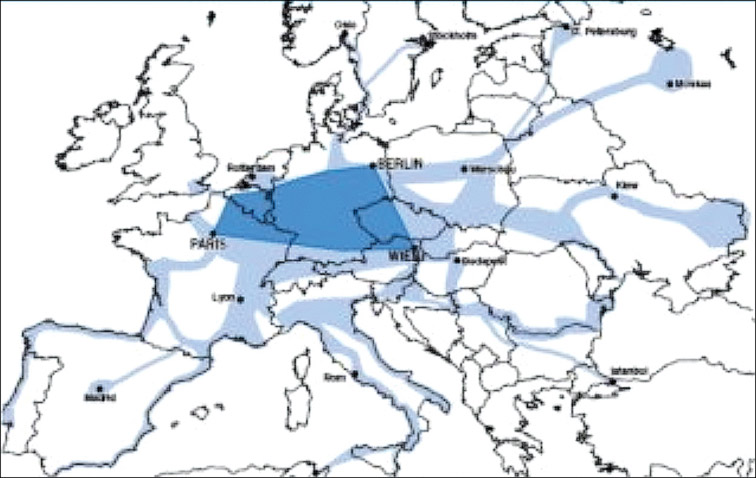
The power lies in essentially two places. In 1988, as earlier, I put forth a policy for the impending collapse of the Soviet system, the Warsaw Pact system. I gave that address in Berlin on October 12, 1988, which happens to be Columbus Day in the United States. And I said that the time had come, that the Warsaw Pact–Comecon system was about to disintegrate—as I had warned over some preceding years, would happen under the present policy; that the unification of Germany was in the immediate view, and obviously Berlin would be the likely choice of a future capital of a reunited Germany; that under these conditions the part of Europe which is essentially an area from Paris, down to Vienna, up across Czechia into Berlin, and back by way of Lille to Paris, is a concentration, historically, of the greatest density of machine-tool-design potential on this planet.
And, that what must be done, and—for example, in most African countries you have no machine-tool capability, design capability. Only in South Africa is there some machine-tool capability of any significance, in all of Africa. That is, machine-tool design capability. And, that this machine-tool-design capability must be hooked up, especially in Asia, to those masses of the population which must have technological progress. And, that we should mobilize the, admittedly impaired, but nonetheless existent resources of the former Soviet economy, to participate in the production of the massive wealth required to meet this requirement for what would be called—or was called—the developing sector of the Third World, at that time.
Well, something different happened. And, Helga [Zepp-LaRouche], when I was in prison, proposed this in 1989 (Ralf Schauerhammer [a close associate of LaRouche—ed.] was part of it; others were part of it)—proposed it as the “European Productive Triangle.” That the center of Europe must mobilize itself for this purpose of transforming the planet by reaching out, in the case of the breakup of the so-called “Cold War apparatus,” to utilize the resources of the former Soviet Union—the productive resources—together with those of Central Europe and elsewhere, in order to reach out and provide technology to these other parts of the world, the so-called Third World. And that, where the idea of developing what I call “spiral arms,” using the analogy of the galaxies, the astrophysical galaxies, must, in transportation, development corridors, must reach out across the world to bring, among other things, to bring such corridors from the Atlantic to the Pacific, and down to the Indian Ocean, and thence into Africa and other continents. That must be the plan.
LaRouche’s European “Productive Triangle”—Paris, Berlin, Vienna. E.I.R. GmbH
Well, it didn’t quite work that way, for various reasons—political reasons. But, then, in the course of things, China picked up on this; and, China called this a “Silk Road Policy.” So, instead of having a proposal which I had originally proposed, of working from Central Europe, from the great concentration of former productive potential, through spiral arms, into other parts of the world, the developing sector, we now have a situation where a developing nation, an old nation but a developing one, China, was now taking the initiative in pushing the same kind of spiral arms back toward Europe, and elsewhere. Now, this, the Chinese call “The Silk Road Project.” We call it generically, “The Eurasian Land-Bridge Project.” And, you’ll hear more about that, as you wish, in the course of the day, and tomorrow.
Now, you saw recently this week something very interesting happened. Let’s go back to the previous week: In Denmark something terrible happened—well, terrible things do happen in Denmark, after all; it’s the nation of Hamlet, right? Where, remember the end of Hamlet, where the—some of you may know that, particularly those who came from Anglophone countries—where, at the end of the drama, Hamlet, who cannot make the decision which would save Denmark in itself, because it’s a strange idea, clings to his old ideas, and he, and Denmark, go into the bucket as a result of this, at the end. And, then, the final word in Shakespeare’s character is to say, Let us reflect upon these events, while they’re fresh in our minds, that we may not repeat this mistake, in a work again. We hope that Denmark never repeats this mistake again.
But, the Danes put out a resolution condemning China. Now, some of you may know, if you’ve followed history at all, that the fellow that became King Edward VII of Britain was very much opposed to an idea which came out of the United States; and came out of the United States by way of Germany and Russia and so forth, which was called the great railroad development project, that we had, in the middle of the 19th Century, we had developed corridors of development across [the continent] from the Atlantic to the Pacific, using railroads.
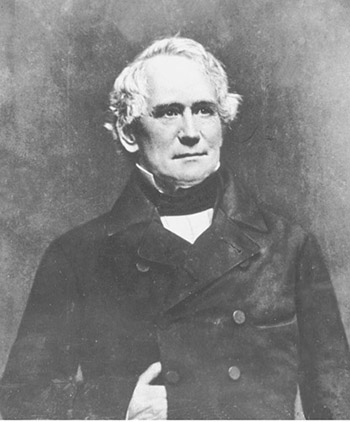
Henry Carey’s Railroad Project
Library of Congress
And, the leader, the political leader, of the United States’ patriotic faction after the assassination of Lincoln, was a fellow from Philadelphia—a rather aged fellow at that point—Henry Carey. And, Henry Carey proposed, with his friends in Europe and elsewhere, proposed the development of a network of railroads from the Atlantic Coast, to the Pacific, and to the Indian Ocean, but, especially from the Atlantic to the Pacific.
Involved in this, before the end of the century, were Japan (which was, until 1894, an ally of the United States against Britain); involved was Sun Yat-sen (who was a protégé of the United States in his youth—again, an enemy of Britain), the father of modern China, and which Beijing again emphasizes today.
And, the idea was, to bring these forces together to develop the great Central Asia thing, and to bring the tool potential of the United States, and of Central Europe, to bear in solving the problem of development of Asia, where the greatest concentration of population is. In response to this, the British organized World War I, and also put Hitler into power—and that’s a fact—in Germany in 1933, in order to prevent this from occurring; because, the natural impulse, from Germany, since this 1876-1879 period, has been this direction. And, you will find in Germany today, despite governments, there still is an impulse toward this kind of development in Central Asia, and so forth.
So, now what has happened, is the Chinese have taken this up. And the British are out to destroy it—the British are out to make war against China. They’re engaged in virtual war against China, they’re involved in war against me, as I hear from Scandinavia recently, and they’re also engaged in (against Clinton) trying to destroy the President of the United States.
Now, here’s what the policy is: You’ve probably noticed the week, after the Danes joined their British masters in attacking China, on human rights (as well as human rights of cannibalism, in the British mind) but, now, in refutation of the fraud which was picked up in the European press, that the United States had sponsored the Danish resolution—which it had not, it was a British concoction, blamed on the United States. The United States government denied that, immediately.
Now there has occurred this past week, in Moscow, a meeting between the President of China and the President of Russia, in which a historic agreement has been reached, which is not final and not definitive, in which Russia will participate, in cooperation with China and with the nations of Central Asia, including Iran, in great development projects. India is in the process of trying to associate itself with this, and has reached agreements and understanding with China on this project.
Recently, you find the reaction to this announcement from Moscow, is that the President of the United States, Clinton, seconded by his Secretary of State, Madeleine Albright (who he apparently has under control, for the time being), and, together with Japan’s Hashimoto, have endorsed this cooperation between the former Soviet Union, in fact, and China.
So, what you have in process, is a great project, the Land-Bridge project, which presents the possibility, of an economic recovery for this planet—that is, a revival of economic activity on a sufficient scale to revive a sinking world economy. This policy is in general supported by the President of the United States.
The Maastricht Suicide Pact
Europe does not function at present. The Europeans could not make a decision on the Balkans; the Europeans can make no decision on anything. Maastricht is not only a suicide pact, it’s like Seneca in the bathtub, committing suicide with many cuts. These are called budget cuts—and that can kill you, too. The Europeans don’t function. The European governments don’t function. They’re killing their economy. France is being destroyed; Germany is being destroyed—every other part of Europe is being destroyed—but, by its own hand! It’s cutting its own throat. There are no burglars in the house. The man of the house is cutting his own throat. So, Europe doesn’t function.
President Edwin Barclay of Liberia (right) and President Franklin D. Roosevelt during World War II, 1943. FDR Library
Apart from the British Empire—which still exists, which my dear friend Godfrey and I agree completely on that; the British Commonwealth is the British Empire. Britain is simply a particular zoological specimen, which is administered by a certain Grand Guignol called a Parliament. The empire and Britain are actually controlled by a Privy Council, which is the agency of an oligarchy, which has selected a certain so-called Royal Family as its Doge, its Venetian-style Doge, hereditary Doge.
But the British Empire, with its financiers, its large corporations, its East India Company–type relics; which controls the entire Commonwealth, which controls their governments, which controls the selection of the ministers of governments of Commonwealth countries, which controls the finances of every Commonwealth country; which controls the foreign policies of Commonwealth countries….
So, that is the kind of situation. That is the enemy power. The only power on this planet which can resist that, is a combination of the government of the United States—the Presidency of the United States—and China, together with a number of other countries which have joined together with them, to do two things. First of all, we require the projects, we require great economic development projects, especially infrastructure projects, spread throughout this planet, to reverse the effects of the past 30 years, and to go on to remedy the great injustice which should have been remedied at the end of World War II. And, Roosevelt would have attempted to do so, if he had lived. That is, to eliminate the injustice of colonialism, and its effects, and to establish equality, as Roosevelt intended. That economic project is the basis for doing it economically.
Secondly, we must rid ourselves of the cause of our present distress, and that distress, of course, takes the form of this great financial, and monetary, and economic collapse.
Now, you have all heard about companies going into bankruptcy, being reorganized in bankruptcy. This system is bankrupt, financially bankrupt, monetarily bankrupt. Therefore, governments must act to put the banks into bankruptcy, to put the monetary system into bankruptcy. We must build a monetary system, a new monetary system, which is in accord with great projects needed to develop the economies of these parts of the world. This cannot be done by the consent of all nations, nor can it be done as a great international discussion ongoing for years.
You’re faced with a situation in which a catastrophe is occurring, the collapse of the financial system. You must act. If you do not act, billions of people will die. You have no time to discuss; you should have discussed it earlier, when you had time. Therefore, the fate of humanity now hangs upon a few powerful decision-makers, who have the power, pre-emptively, to force the system into bankruptcy reorganization, and to create a new system which is more equitable, and is in agreement with our economic purposes.
The only agencies which can conceivably do that, on this planet, are the partners of an agreement between the President of the United States and China. That is enough power, with the support of Third World countries which will welcome it, to break the power of the present system, the IMF system, as people like to call it.
There’s another ingredient to this process, however. Intellectually—I don’t need to go through it here, because I’ve written about it so much—intellectually, there are certain specifications which will make the system work. There are precedents for what we propose, established precedents. That’s not the problem. Where are we going to find the passion to act on those ideas which are the solution? It’s something which is called in the Greek, and in the New Testament Greek, agapē. All of you know it, whenever you did an act of discovery of a valid principle, a rediscovery, as in school, or someplace: You tried to relive the process of a great discovery. And, you went through the paradox, the previous belief, the evidence against the previous belief, and you tried to resolve that paradox, you tried to find out what was the truth, a higher truth, than you had known before. How did you do that, if you did it? You had to sustain your concentration. You had to develop a certain kind of emotional power, which would enable you to force yourself to stay with the problem, not to go to sleep on it, until you’d reached a solution. It’s the power of agapē. There must be passion. A computer has no intellect! It has no passion to solve problems! It is passion.
The Passion of Africa
Let’s speak, in the Christian sense, of the passion of Africa. The passion of Africa can be a key part of impelling governments, such as the partners of an effort between the United States Presidency and China, to solve this crisis. To use the existing ideas, which could solve the crisis, and make them real.
What is Africa? We in the United States, working from the United States, are aware that nobody seems to care about Africa anymore, in governments. There is no constituency for Africa in the United States. There may be people who say there’s a constituency for Africa in the United States, but it doesn’t exist, as Jacques Bacamurwanko [former Burundi ambassador to the U.S.] can tell you. It can be created, however. And that’s one of the things we’re doing. It can be created around the world.
What is happening to Africa now, the horror of it, must be made clear to the governments—I think China will accept it—but the government of the United States and others, and forces around it. The horror. The fact that we allow, that the nations allow what has been going on in Africa, especially in the recent years, to continue, is a condemnation of the conscience of the nations. And to these nations we can say, that if you continue to allow this to happen in Africa, you do not have the morality or the impulse required to save your own selves from the crisis which is coming down.
So, we must, with our weakness—and I speak of “we” in Africa, in this case—we must use our very weakness, as a force to move the great powers. And that power we have, in weakness, is to use the full horror, even by name, of the child who died by the road… To say, that person died, that child died, that woman died, that man died, but they’re not just cattle! These are individual human beings, who are dying in the hundreds of thousands, approaching the millions. They are being murdered. They are being murdered by the people that you are hosting, as being salonfähig [socially acceptable], in the governments, and similar proceedings, in the United States as well as in Europe and Britain. Which the press of Europe and the United States is praising as the great figures….
What about the faces, what about the individuality, what about the personality, the possible future, of that child or that woman or that family? What are we going to say? We have the test of death, which we have to face in our own life. That is, did we simply use this mortal existence to get pleasure and satisfaction, or did we use the talent given to us, to return it when we died, somewhat enriched? Did we make something of our lives, as they say in simple language.
Also, we are accountable for what we do to others! Not just to ourselves. There’s a human being: who knows what potential is lost when that person dies, as a child, by the side of the road? And they’re stacked up like cord wood on the side of the road!…
That is the passion. If you allow that, what about your child, your sister, when the time comes. Who will weep for them? If you can allow this, you lack the moral fitness to survive, and the record of history is clear. In the fall of empires and entire civilizations, when mankind makes a mistake, in ruling ideas, mankind is punished by calamities. And when civilizations do not respond to the calamities thus brought upon them, then the universe is so designed, by the Creator, that it does something to purge itself of that disease, which that civilization has become. And this is such a time. And thus, in Africa, I think, as I said at the beginning, to understand Africa, we here, in this room, must not allow ourselves to be so involved with the details on the ground, that we lose sight of that knowledge and overview which is needed to win.
We must rise to the mountaintop, from which we can see the past and the breadth of humanity, at least for some distance. See what has happened to humanity, and use our knowledge of the problems which are confronted in the centers of power, to use the very horror of what has been done, the crimes that are being committed in Africa, to use that as a lever, to force people to discover, within themselves—including the President of the United States—to discover the passion to do what is necessary to save all humanity.
C From Helga Zepp-LaRouche
Ten Principles of a New International Security & Development Architecture
Proposed by Schiller Institute founder Helga Zepp-LaRouche, November 30, 2022.
Helga Zepp-LaRoucheFounder, The Schiller Institute
First: The new International Security and Development Architecture must be a partnership of perfectly sovereign nation states, which is based on the Five Principles of Peaceful Coexistence and the UN Charter.
Second: The absolute priority must be to alleviate poverty in every nation on the planet, which is easily possible, if the existing technologies are being used for the benefit of the common good.
Third: The life expectancy of all people living must be prolonged to the fullest potential by creating modern health systems in every country on the planet. This is also the only way how the present and future potential pandemics can be overcome or be prevented.
Fourth: Since mankind is the only creative species known so far in the universe, and given the fact that human creativity is the only source of wealth through the potentially limitless discovery of new universal principles, one of the main aims of the new International Security and Development Architecture must be providing access to universal education for every child and adult person living. The true nature of man is to become a beautiful soul, as Friedrich Schiller discusses this, and the only person who can fulfill that condition is the genius.
Fifth: The international financial system must be reorganized, so that it can provide productive credits to accomplish these aims. A reference point can be the original Bretton Woods system, as Franklin D. Roosevelt intended it, but was never implemented due to his untimely death, and the Four Laws proposed by Lyndon LaRouche. The primary aim of such a new credit system must be to increase dramatically the living standard of especially the nations of the Global South and of the poor in the Global North.
Sixth: The new economic order must be focused on creating the conditions for modern industries and agriculture, starting with the infrastructural development of all continents to eventually be connected by tunnels and bridges to become a World Land-Bridge.
Seventh: The new global security architecture must eliminate the concept of geopolitics by ending the division of the world into blocs. The security concerns of every sovereign nation must be taken into account. Nuclear weapons and other weapons of mass destruction must be immediately banned. Through international cooperation, the means must be developed to make nuclear weapons technologically obsolete, as it was originally intended by the proposal which became known as the SDI, suggested by LaRouche and made as an offer to the Soviet Union by President Reagan.
Eighth: In former times, one civilization at one corner of the world could go under, and the rest of the world would only find out years later, due to the length of distances and the time needed for travel. Now, for the first time, because of nuclear weapons, pandemics, the internet, and other global effects, mankind is sitting in one boat. Therefore, a solution to the existential threat to humanity cannot be found with the help of secondary or partial arrangements, but the solution must be found on the level of that higher One, which is more powerful than the Many. It requires the thinking on the level of Coincidentia Oppositorum, the Coincidence of Opposites, of Nicholas of Cusa.
Ninth: In order to overcome the conflicts arising out of quarreling opinions, which is how empires have maintained control over the underlings, the economic, social and political order has to be brought into cohesion with the lawfulness of the physical universe. In European philosophy this was discussed as the being in character with natural law, in Indian philosophy as cosmology, and in other cultures appropriate notions can be found. Modern sciences like space science, biophysics or thermonuclear fusion science will increase the knowledge of mankind about this lawfulness continuously. A similar cohesion can be found in the great works of classical art in different cultures.
Tenth: The basic assumption for the new paradigm is, that man is fundamentally good and capable to infinitely perfect the creativity of his mind and the beauty of his soul, and being the most advanced geological force in the universe, which proves that the lawfulness of the mind and that of the physical universe are in correspondence and cohesion, and that all evil is the result of a lack of development, and therefore can be overcome.
A new world economic order is emerging, involving the vast majority of the countries of the Global South. The European nations and the U.S. must not fight this effort, but by joining hands with the developing countries, cooperate to shape the next epoch of the development of the human species to become a renaissance of the highest and most noble expressions of creativity!
Let us therefore create an international movement of World Citizens, who work together to shape the next phase in the evolution of mankind, the new epoch! World Citizens of all countries, unite!
Conceived by Lyndon and Helga Zepp-LaRouche in the early 1990s as a global policy of “Peace Through Development” — corridors of rail, water, and power uniting every continent. Click a pulsing marker to explore a featured project.
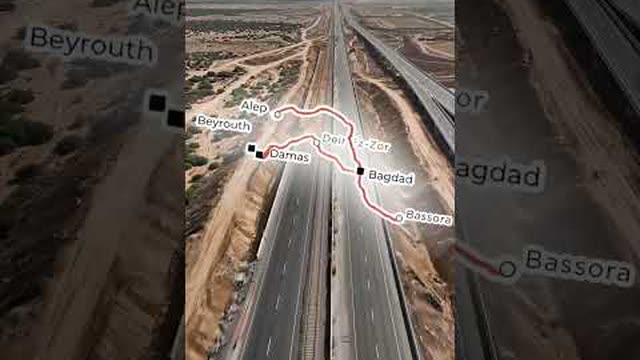
A fifty-year development perspective for Palestine and Israel, first proposed by Lyndon LaRouche in 1975: peace built not on paper treaties, but on the physical economy — water, power, and transport for all the peoples of the region.
Nuclear-powered desalination to create abundant fresh water where geopolitics now fights over scarcity
New canals, rail corridors, and development cities linking the region into the World Land-Bridge
▶▶ Click to play — video loads from YouTube (Google). Privacy
Featured project · Africa
Transaqua
The great project to refill Lake Chad — transferring a small fraction of the water of the Congo River basin northward through a ~2,400 km navigable canal, bringing water, power, and transport to the heart of Africa.
Would benefit some 40 million people across 12 nations
A navigable waterway spine for inland Africa: irrigation, hydropower, and commerce
Restores the shrinking Lake Chad — turning a security crisis into a development driver
▶▶ Click to play — video loads from YouTube (Google). Privacy
Featured project · South America
Chancay Port & the Bioceanic Corridor
⬡ Draft copy — the pamphlet document leaves this section open; the projects below are taken from the World Land-Bridge map and can be replaced.
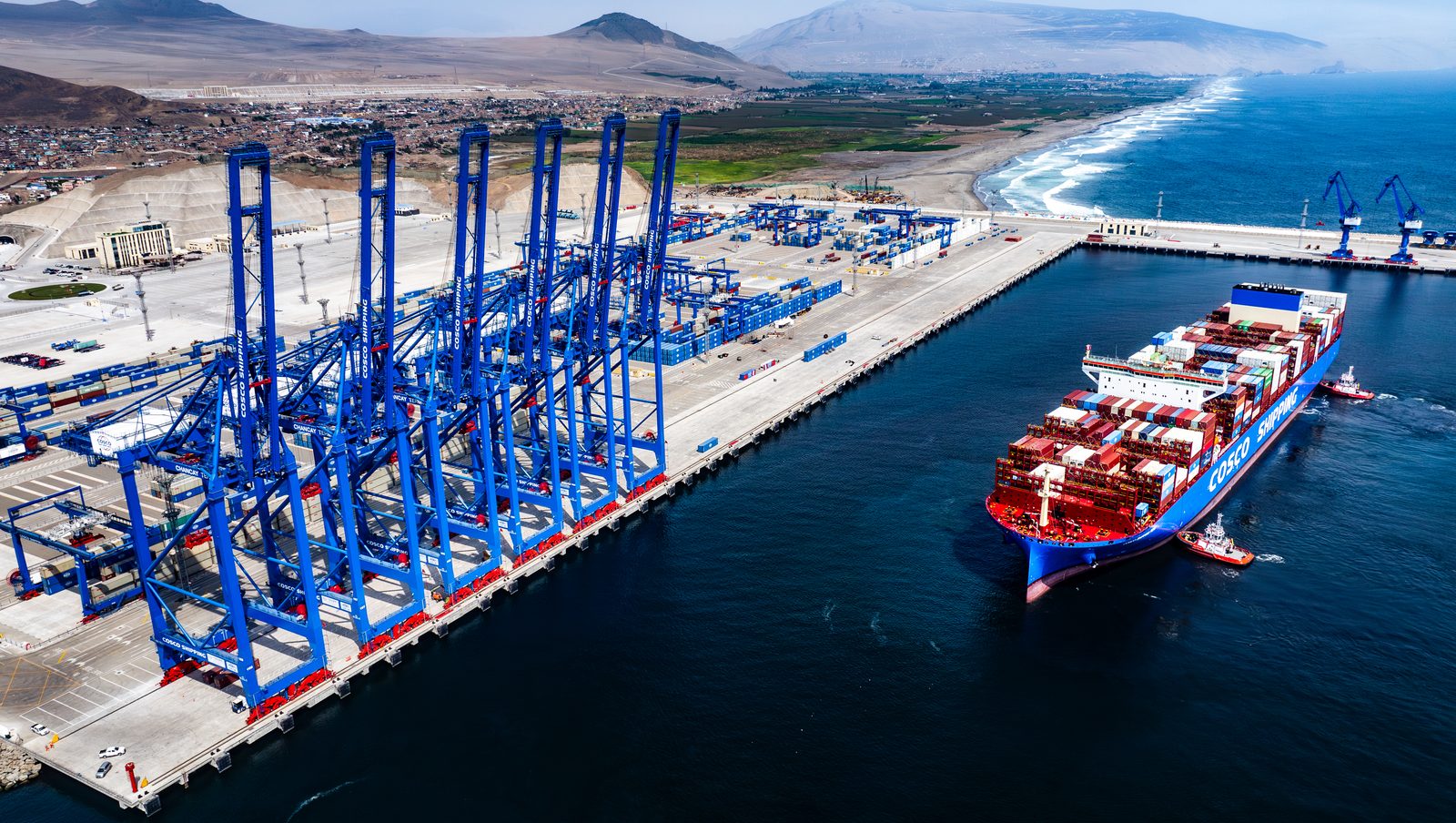
The deepest-water port in South America, at Chancay, Peru, joins a bioceanic rail corridor linking the Pacific coast to the Atlantic coast of Brazil — cutting Shanghai-to-South-America shipping times by up to a quarter and opening the continent’s interior to development.
8,000+ direct jobs and an estimated $4.5 billion in annual revenue
Rail spine magnifying the impact of the port across the whole continent
⬡ Placeholder — the featured Bronx project is to be announced.
The World Land-Bridge is not only about distant continents — it is a mission for every community. The Bronx section will feature the youth movement’s local organizing and a concrete development project for New York, connecting the neighborhood to the world.
Featured project text to be supplied
Local youth-movement activities and events
How to get involved on the ground
▶▶ Click to play — video loads from YouTube (Google). Privacy
E Voices of Global Majority
Voices of the World Majority
A series of video interviews with representatives of the Global South — statesmen, scientists, and youth leaders — from Executive Intelligence Review’s YouTube channel.
▶▶ Click to play — video loads from YouTube (Google). Privacy
Dr. Seyed Mohammad Marandi: Causes of the War Against Iran and the Prospects for PeaceDr. Seyed Mohammad Marandi — Professor, University of Tehran
▶▶ Click to play — video loads from YouTube (Google). Privacy
Dignity in the Face of Genocide and War: The Mission of Yemen's YouthFadel Abdo Al-Dhyani — head of the Youth Development Association of the Republic of Yemen
▶▶ Click to play — video loads from YouTube (Google). Privacy
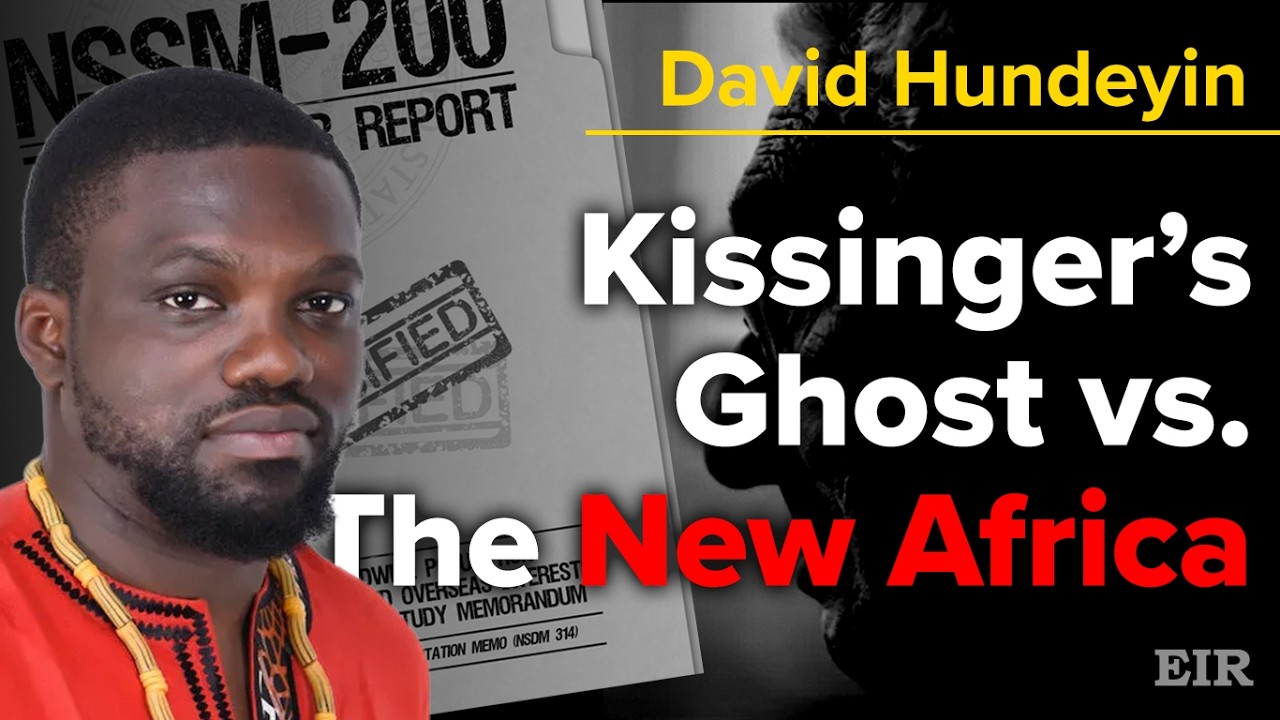
Kissinger's Ghost vs. The New Africa: David Hundeyin on NSSM 200 & the BRICS ParadigmDavid Hundeyin — journalist and founder of The Spearhead
“…we seek to be free from oligarchy, because not to do so would be to betray the divine spark of reason in ourselves and in others.”
— Lyndon LaRouche, 1990 · “In the Garden of Gethsemane”
Highlights · December 2025
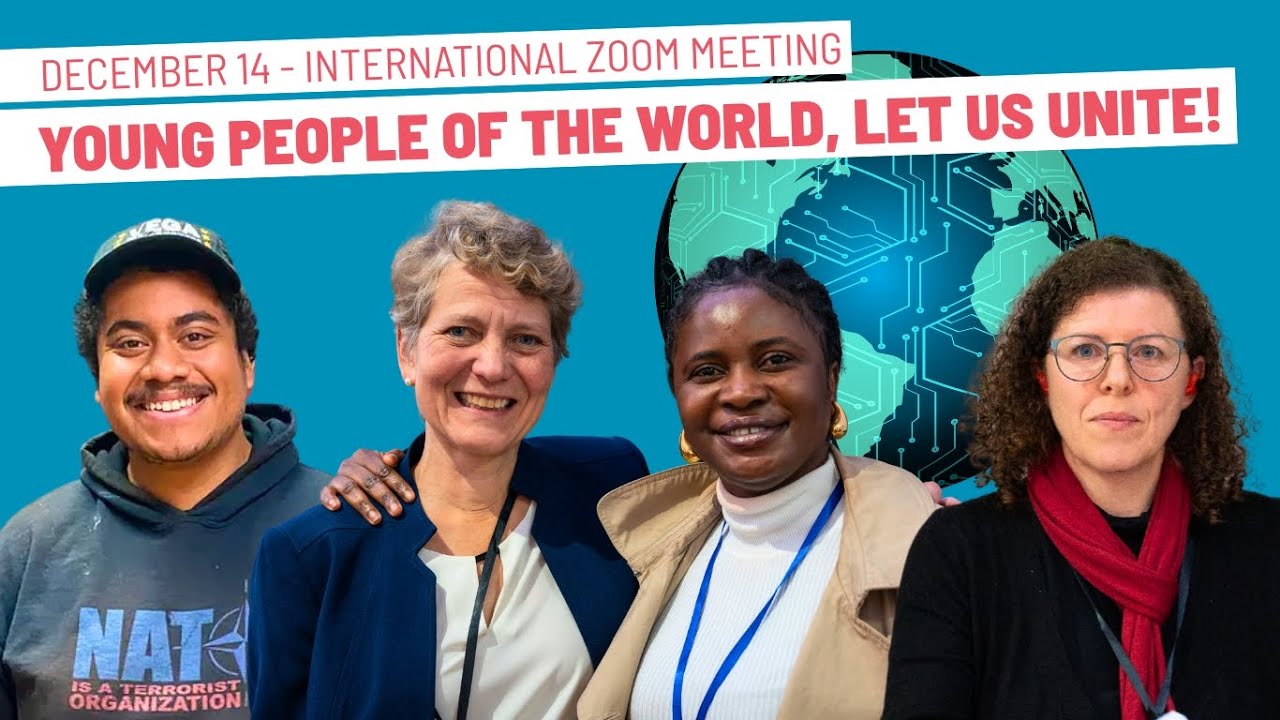
International Online Youth Conference “Young People of the World, Unite!”
Young people from across six continents gathered online to take up the fight for a new paradigm. Watch the highlights, then take your place in what comes next.
EIR · Weekly Journal
Subscribe to Executive Intelligence Review
The weekly journal founded by Lyndon LaRouche. Study the ideas behind the movement.